Hormonal Migraine: Track Your Menstrual Cycle Pattern
Hormonal migraine can follow menstrual timing. Learn the cycle window, keep a practical symptom diary, and bring clearer questions to your doctor. Start today.
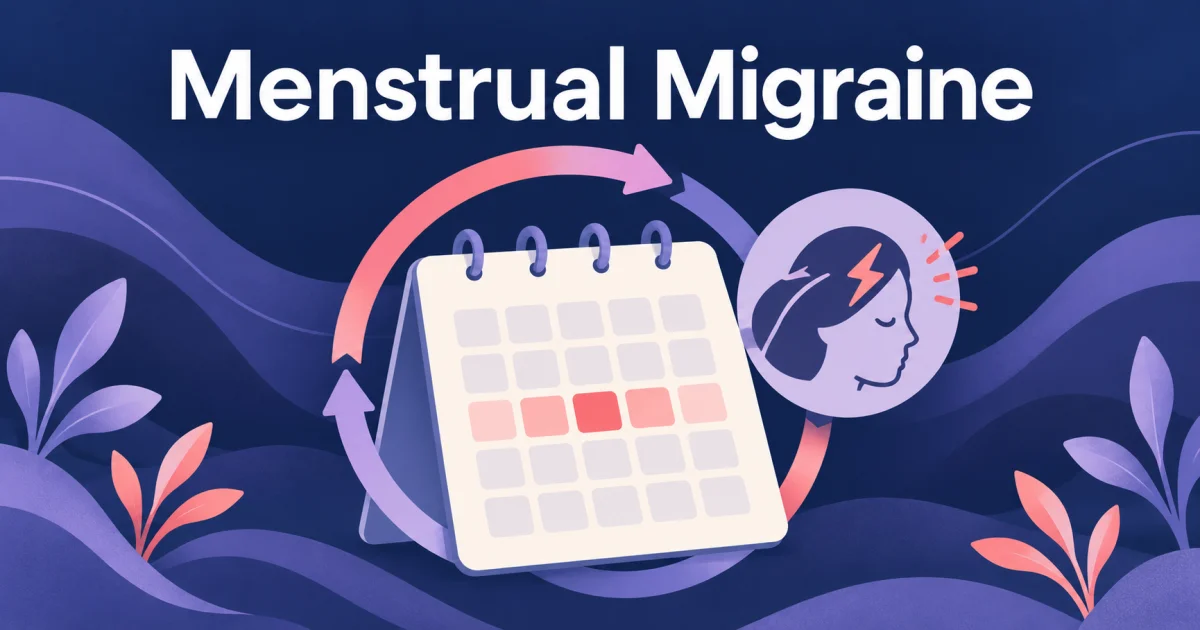
If headaches seem to cluster around your period, you may wonder whether the timing matters or whether you are simply noticing a coincidence. Recording the actual dates can give that question a clearer starting point. “Hormonal migraine” is an informal description of migraine associated with hormone changes; menstrual migraine refers to a recurring pattern of migraine attacks around menstruation.
What does hormonal migraine mean?
Hormonal migraine describes an association between migraine and hormone changes, rather than one single diagnosis. Estrogen fluctuations can influence migraine patterns, but timing and symptoms still need an individual assessment.
The American Migraine Foundation describes changes in migraine around menstruation and perimenopause. A fall in estrogen before a period is one explanation for the menstrual pattern. That does not mean every headache during a period is migraine, or that every migraine attack at another point in the month has a hormonal cause.
Start by describing the headache and associated symptoms. If the headache type has not been assessed, ask a clinician rather than relying on cycle timing to label it. Our guide to migraine versus other headaches explains the broad distinctions, but the diagnosis remains a clinical decision.
The practical question is often modest: “Do my recorded attacks repeatedly fall near bleeding?” You can investigate that without a hormone test, an exact cycle prediction, or a complicated scoring system.
Which cycle days count as the menstrual migraine window?
ICHD-3 defines the menstrual window as days −2 to +3, with the first bleeding day counted as day 1 and no day 0. This means the two days before menstruation and the first three bleeding days.
The numbering can be confusing, so use a calendar. In this hypothetical example, bleeding begins on 10 October:
| Calendar date | Cycle-relative day | Within the window? |
|---|---|---|
| 8 October | −2 | Yes |
| 9 October | −1 | Yes |
| 10 October | 1, first bleeding day | Yes |
| 11 October | 2 | Yes |
| 12 October | 3 | Yes |
| 13 October | 4 | No |
The ICHD-3 definition of menstrually-related migraine without aura requires attacks in this window in at least two out of three cycles, with attacks also occurring at other times. Pure menstrual migraine without aura uses the same recurring window but no attacks elsewhere in the cycle.
These are clinical classification criteria, not a self-diagnosis checklist. Attacks must also meet the relevant migraine criteria, and the clinician considers alternative explanations. ICHD-3 recommends a prospective diary for research but does not require one for every clinical diagnosis.
If you notice a broader or different pattern, keep the actual dates. You do not need to force every observation into the defined window to make it worth discussing.
How can you keep a useful cycle and headache diary?
Record bleeding and symptoms as they happen, using calendar dates before interpreting a pattern. Keep headache-free days, attacks outside the menstrual window, and missing entries visible.
Start with an observation record rather than a prediction:
Date:
Bleeding: no / yes / uncertain; first day if applicable
Head pain: no / yes / not recorded
Head pain start and end times:
Pain severity and effect on activity:
Other symptoms, including visual or sensory symptoms:
Medicines used: exact name, dose, and time
Relevant context or recent changes:
Anything uncertain:
You can add cycle-relative day numbers after the bleeding start is known. If the start date is unclear, mark it as unclear and ask your clinician how they want it recorded. Do not use an estimated next period to overwrite the dates you observed.
For a small summary across cycles, try this original template:
Cycle bleeding start:
Dates of attacks near bleeding:
Dates of attacks elsewhere in the cycle:
Headache-free days recorded:
Missing dates:
Main effect on daily life:
Question I want to discuss:
Keep the underlying dates even if you make a summary. For example, “head pain on 9 and 11 October; bleeding began 10 October” is clearer than “hormonal migraine this month.” Three cycles give you a way to compare the recurring pattern described in ICHD-3, but you should seek care when needed rather than wait to complete the record.
Our migraine journal guide has a fuller daily template. Add cycle observations in notes if your chosen tracker does not have a dedicated field.
What if your periods are irregular or your pattern changes?
With irregular periods, record observed bleeding dates and symptom dates without assuming a standard cycle length. Changes in the pattern are useful information to bring to a clinician.
Perimenopause is the transition toward menopause and can involve irregular cycles; AMF notes that migraine may worsen during this transition. Some people improve after menopause, but this is not a promised outcome or a reason to wait through disabling symptoms.
For a practical record, make a note of a change and when it happened: “bleeding has become less predictable over the last several months” or “headache days no longer cluster near bleeding.” Keep the date of any clinician-directed contraception or hormone therapy change alongside the symptom record. Do not decide from timing alone that a new product caused or prevented an attack.
If there was no bleeding in a particular interval, record that observation and the headaches that occurred. A calendar entry still has value even when a cycle-relative day number is unavailable. You can bring questions about irregular bleeding to the clinician who manages your menstrual health, alongside the headache assessment.
How can you avoid blaming every attack on hormones?
Compare the menstrual pattern with attacks elsewhere in the cycle and with relevant daily context. An association can be meaningful without explaining every episode.
Suppose a hypothetical diary shows two attacks near bleeding, one after a disrupted night, and another with no obvious change. Preserve all four observations. Removing the exceptions would make the pattern look more certain than the record supports.
If cravings, neck discomfort, or fatigue appear before head pain, write the order of events. AMF explains that some suspected triggers can actually be prodrome symptoms, meaning the attack may already have begun. “Craved a snack before pain” is therefore a safer observation than “the snack caused the migraine.”
You can also note sleep changes or caffeine amount and timing when they are relevant. You do not need to record every detail of your day or avoid a growing list of foods. Ask your clinician which observations would help with your particular pattern.
What should you discuss with your clinician?
Bring the timing record, symptom descriptions, functional impact, and any contraception or hormone therapy history. Ask how the observed pattern affects the assessment and what plan fits your health history.
A short set of questions can keep the discussion focused:
- Does this record suggest a menstrual relationship, or do you need other information?
- Should I record symptoms differently if I have aura?
- How should we evaluate attacks outside the menstrual window?
- What should I do if symptoms change or attacks remain disabling?
- Who should coordinate headache care with my menstrual or contraceptive care?
Contraceptive choices require individual assessment. NICE advises against routinely offering combined hormonal contraceptives to people with migraine with aura. This is a reason to discuss aura and personal risks with a clinician, not an instruction to stop or switch a prescribed product yourself.
A cycle pattern should not explain away a sudden severe headache or new neurological symptoms. Mayo Clinic advises prompt assessment of concerning new or changed headache symptoms; seek emergency care immediately or call local emergency services for a sudden severe headache or new weakness, confusion, or vision loss.
Calma can keep attack and symptom entries together and export PDF or CSV reports for a headache appointment. Put observed cycle dates in notes where needed, and review the actual dates with your clinician. A manageable diary can support that conversation without promising a diagnosis or predicting the next attack.
Download on the App StoreFrequently Asked Questions
These answers explain the timing terms and common tracking choices.
When does menstrual migraine usually occur?
ICHD-3 uses a window from two days before menstruation through the third day of bleeding, in at least two out of three cycles. The first bleeding day is day 1, and there is no day 0; a clinician must also assess whether the attacks meet migraine criteria.
What is the difference between pure menstrual and menstrually-related migraine?
In the ICHD-3 definitions for migraine without aura, pure menstrual migraine occurs only in the menstrual window. Menstrually-related migraine also occurs at other times of the cycle.
How can I track hormonal migraine with irregular periods?
Record actual bleeding dates and headache or other symptom dates as they happen, without assuming a fixed cycle length. Mark uncertain dates and share the diary with your clinician; an irregular cycle does not make the record useless.
Should I change birth control because of migraine?
Discuss migraine and any aura symptoms with the clinician who manages your contraception before changing it. The choice depends on your medical history and individual risks, and a diary alone cannot determine which option is suitable.
Sources
These clinical sources support the definitions and health guidance; the calendar example and templates are illustrative.
- International Headache Society. ICHD-3: Pure menstrual migraine without aura.
- International Headache Society. ICHD-3: Menstrually-related migraine without aura.
- American Migraine Foundation. Hormonal and Menstrual Migraine.
- American Migraine Foundation. The Science Behind Migraine Triggers.
- National Institute for Health and Care Excellence. Headaches in over 12s: Recommendations.
- Mayo Clinic. Migraine: Symptoms and causes.
Related Articles

Caffeine and Migraine: Track Your Amount and Timing
Caffeine and migraine have a complex link. Learn how amount, timing, and withdrawal affect your diary, then track observations to discuss with a doctor.

Migraine and Weather: Evidence, Patterns, and Planning
Explore the evidence on migraine and weather, learn what to record on headache-free days, and build a practical diary to discuss patterns with your doctor.
Sleep Deprivation and Migraine: What to Track and Try
Learn how sleep deprivation and migraine may interact, what research can tell you, and how to track sleep patterns for a useful conversation with your doctor.