Migraine and Weather: Evidence, Patterns, and Planning
Explore the evidence on migraine and weather, learn what to record on headache-free days, and build a practical diary to discuss patterns with your doctor.
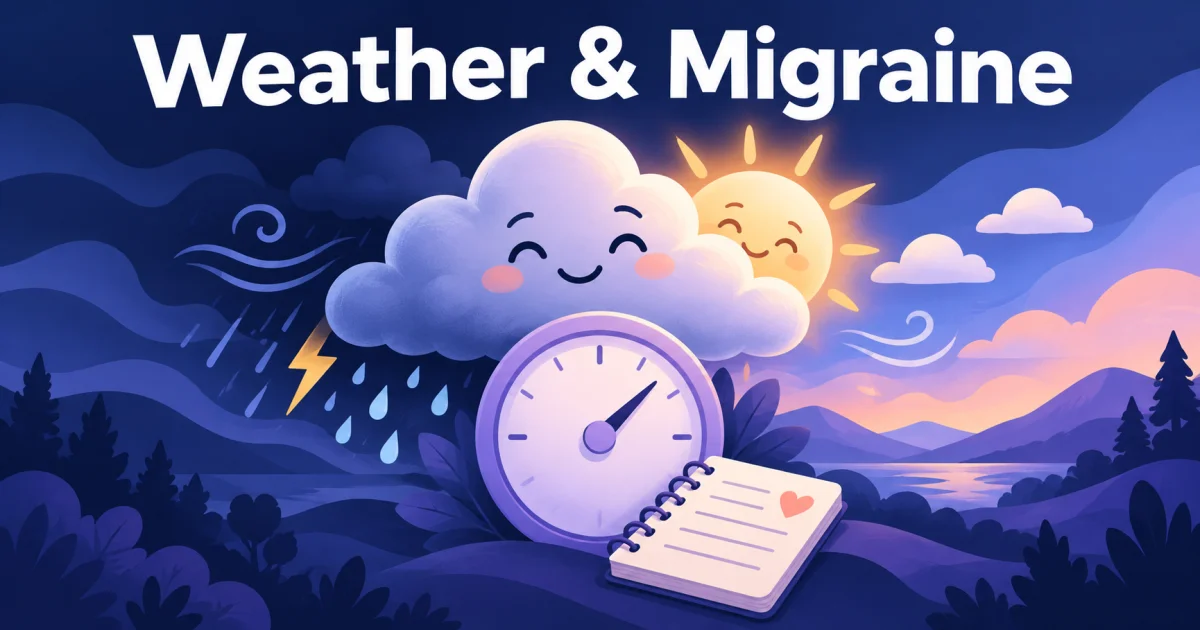
Migraine and weather can seem closely connected when a storm arrives just before an attack. Barometric pressure, temperature, humidity, and bright sunlight are all possible parts of the picture. Yet weather changes also alter daily routines, and research does not identify a universal pattern that predicts an individual's next migraine.
The useful question is narrower: do particular conditions repeatedly coincide with your symptoms, including when other parts of your day stay similar? A simple record can help you investigate that question without reorganizing your life around every forecast.
What does the research say about weather and migraine?
Weather may matter for some people, but the evidence is mixed. Different studies measure different conditions, locations, and outcomes, so a result from one population should not become a rule for everyone.
A prospective study of 238 people in Vienna compared headache diaries with weather records over 90 days. Several initial associations disappeared after the researchers adjusted for testing many possibilities. That study did not establish a clear, consistent weather effect.
In a Boston study of 98 adults with episodic migraine, humidity was associated with headache onset during the warmer season. Temperature and barometric-pressure associations were generally absent, and some results changed under alternative analyses. This illustrates why the wording “weather causes migraine” is too simple.
A 2025 systematic review pooled research and reported associations with temperature and atmospheric pressure, but not a significant overall association with humidity. Pooled associations still cannot tell an individual whether tomorrow's conditions will cause symptoms. The studies do not provide a personally validated forecast.
These findings leave room for an individual pattern without making every suspected pattern certain. Your experience deserves attention, and it also deserves a careful comparison.
Which weather details are worth recording?
Start with the condition you actually suspect, plus enough context to interpret it. There is no need to collect every number on a weather dashboard.
Barometric pressure means the pressure of the surrounding atmosphere. If it is your main concern, note whether pressure was rising, falling, or relatively steady according to one consistent local source. Record your location, particularly when traveling. A measurement from a distant airport may describe your surroundings imperfectly.
| Detail | A useful note | What it cannot establish |
|---|---|---|
| Pressure | “Falling during the afternoon” | A universal attack threshold |
| Temperature | “Hot commute; mostly indoors afterward” | How much heat you personally experienced |
| Humidity | “Humid day; outdoors for an hour” | Whether humidity caused symptoms |
| Light | “Strong glare through the office window” | Whether weather or another light source mattered |
| Timing | “Headache began before rain started” | Whether an earlier exposure was causal |
The American Migraine Foundation's seasonal guide also discusses sunlight, heat, routine changes, and hydration. These factors can occur together. For example, a hot day might involve an uncomfortable commute and a late meal, rather than temperature acting alone.
Keep your notes descriptive. “Storm and headache on the same day” preserves what you observed. “Storm caused headache” adds a conclusion your record has not yet established.
Why do headache-free days matter?
Days without headache provide the comparison that an attack-only diary is missing. If you only check the weather when you feel ill, you will never see how often similar weather passes without symptoms.
Consider this hypothetical example, which is not Calma user data:
| Day | Weather | Other circumstances | Outcome |
|---|---|---|---|
| Monday | Falling pressure | Usual sleep; meals on time | No headache |
| Thursday | Falling pressure | Interrupted sleep; late lunch | Headache at 3 p.m. |
| Saturday | Stable pressure | Interrupted sleep; late lunch | Headache at 2 p.m. |
This small example does not prove a sleep or meal trigger either. It shows why pressure alone is an incomplete explanation. The same pressure pattern occurred without headache, and headache occurred without it.
Look for both confirming and disconfirming days. Ask: how often did the suspected weather condition occur, and on how many of those days did symptoms occur? A single memorable storm is less informative than repeated observations across ordinary days.
Our guide to keeping a migraine journal offers a practical template. You can add brief weather observations to diary notes without needing a specialized forecast feature.
How can you separate weather from other circumstances?
You cannot fully separate possible causes with a personal diary, but you can make the pattern easier to assess. Record a few recurring circumstances alongside weather rather than assuming the most noticeable event was responsible.
A manageable daily checklist is:
- Headache: yes, no, or unknown; onset time and main symptoms when present.
- Weather: the condition you are investigating and your location.
- Sleep: approximate timing, interruptions, and whether you felt rested.
- Meals and drinks: substantial changes in your usual routine.
- Stress and activity: an unusually demanding day, travel, or extended outdoor time.
- Care: relevant medication use and what happened afterward, recorded without changing your prescribed plan.
Use the same short categories each day. Leave an honest “unknown” when you do not remember something. Reconstructing exact details from memory can create a tidier but less reliable record.
If sleep repeatedly changes with the seasons, the sleep and migraine guide can help you decide what to record. For a wider view, see common migraine triggers. Neither guide requires you to identify one perfect explanation for every attack.
What can you do when the forecast looks uncomfortable?
Plan for comfort and continuity, without treating the forecast as a warning that an attack must happen. Practical preparation can be worthwhile even when the suspected weather association is uncertain.
The American Migraine Foundation's summer guidance suggests shade, access to a cool space, water, and a regular routine. Adapt those ideas to your circumstances: bring a hat for a bright journey, keep a meal accessible during travel, or allow a break after a hot commute.
Choose a small adjustment that addresses the actual discomfort. You do not need to cancel every outdoor plan or monitor pressure repeatedly throughout the day. If glare is the problem, read about light sensitivity and screens rather than assuming atmospheric pressure is responsible.
Keep following the care plan you have agreed with your clinician. A forecast is not a reason to start, stop, or reschedule medication on your own.
When should you discuss a suspected weather pattern?
Discuss it when attacks interfere with life, change in character, or remain difficult to manage. Bring a summary of both symptomatic and headache-free days so the conversation is about a pattern rather than a single storm.
Useful questions include: “Does this timing suggest anything worth investigating?” and “What should my plan be when symptoms begin?” A weather diary supports that conversation; it does not replace an assessment.
A sudden, extremely severe headache or new weakness, confusion, or speech difficulty needs emergency assessment, whatever the weather. NHS migraine guidance describes these warning signs. Do not explain a new emergency symptom away as your usual weather sensitivity.
Calma can help keep your migraine records together. Add the environmental details that matter to you in your notes, and use them as questions for care rather than predictions.
Download on the App StoreFrequently Asked Questions
Can changes in weather trigger migraine?
Weather may be associated with attacks for some people, but studies report mixed results. A repeated diary pattern can help you discuss suspected sensitivity with a clinician; it does not prove that weather caused an attack.
Does falling barometric pressure always cause migraine?
No. There is no pressure change that reliably causes an attack in everyone. Record pressure alongside symptoms and other circumstances, including on headache-free days, rather than treating a forecast as a prediction.
What should I record when I suspect a weather trigger?
Record the date, location, headache onset and symptoms, local weather, sleep, meals, stress, and relevant medication use. Include days without headache so you can compare similar conditions with different outcomes.
Can a weather app predict my next migraine?
A weather app can describe environmental conditions, but a weather forecast alone cannot tell you whether you will have a migraine attack. Use it for practical planning alongside your care plan, without assuming an attack is inevitable.
Sources
- Zebenholzer and colleagues: Migraine and weather, prospective diary study
- Li and colleagues: Weather, ambient air pollution, and migraine onset
- Li and colleagues: Association between weather conditions and migraine, 2025 systematic review
- American Migraine Foundation: Seasonal Migraine Triggers
- American Migraine Foundation: Making the Most of Summer With Migraine
- NHS: Migraine
Related Articles

Caffeine and Migraine: Track Your Amount and Timing
Caffeine and migraine have a complex link. Learn how amount, timing, and withdrawal affect your diary, then track observations to discuss with a doctor.
Hormonal Migraine: Track Your Menstrual Cycle Pattern
Hormonal migraine can follow menstrual timing. Learn the cycle window, keep a practical symptom diary, and bring clearer questions to your doctor. Start today.
Sleep Deprivation and Migraine: What to Track and Try
Learn how sleep deprivation and migraine may interact, what research can tell you, and how to track sleep patterns for a useful conversation with your doctor.