Why Keeping a Migraine Diary Can Cut Your Attacks in Half
Research shows migraine tracking can reduce attack frequency by 30–50%. Learn how a consistent diary reveals your personal triggers and transforms your treatment plan.

Why Keeping a Migraine Diary Can Cut Your Attacks in Half
If you live with migraines, you've probably tried countless treatments hoping for relief. What if the most powerful tool for reducing your attacks was something as simple as keeping a record of when they happen?
Migraine is a neurological disorder affecting hundreds of millions of people worldwide. Attacks bring severe head pain lasting 4 to 72 hours, often accompanied by nausea and sensitivity to light. A tracking diary creates a systematic log of attack timing, severity, symptoms, and potential triggers, transforming invisible patterns into actionable insights.
Research consistently shows that migraine tracking is one of the most effective tools in migraine management. Studies indicate that patients who track diligently can reduce attack frequency by 30 to 50%, simply by identifying and addressing their personal triggers.
Does Migraine Tracking Actually Reduce Attack Frequency?
Migraines are not random. They follow patterns influenced by triggers, hormones, sleep quality, and environmental factors that are impossible to detect without systematic data. By recording your attacks over weeks and months, correlations that seemed invisible suddenly become clear.
Research has found that structured migraine monitoring, combined with personalized feedback, leads to a statistically significant reduction in monthly migraine days. Furthermore, the American Headache Society recommends headache diaries as a standard component of migraine management for exactly this reason.
Clinical evidence supports this approach. Patients who maintained detailed diaries identified meaningful trigger patterns over time. Diary-based trigger management reduced attack frequency by 30 to 40% in controlled studies. Patients with diary records had more productive neurology appointments and received more targeted treatment adjustments. Tracking also improves detection of medication overuse headache, a common complication that often goes unrecognized without objective data.
Citation capsule: The American Headache Society recommends headache diaries as standard migraine management, supported by clinical evidence showing diary-based trigger management reduces attack frequency by 30–40% in controlled studies. Patients with diary records receive more targeted treatment adjustments and are more likely to detect medication overuse headache before it becomes entrenched.
What Should You Track in a Migraine Diary?
Effective tracking goes beyond marking attack days on a calendar. The more context you capture, the faster patterns emerge. If you're unsure where to start, begin with the 10 most common migraine triggers as your baseline checklist.
For essential tracking, record the date and time of attack onset and when it resolves. Use a consistent 0 to 10 scale for pain severity. Note the pain location and quality, whether it's throbbing, pressure, one-sided, or bilateral. Document associated symptoms like nausea, vomiting, aura, and sensitivity to light, sound, or smell. Track medications taken and how effective they were on the same 0 to 10 scale. Finally, note suspected triggers in the 24 to 48 hours before onset.
Once the habit becomes established, you can add advanced details. Sleep quality and total hours the night before often correlate with attacks. For women, menstrual cycle day matters because hormonal migraines are extremely common. Meal timing and unusual foods consumed can reveal delayed food triggers. Note exercise type and intensity, as well as weather and barometric pressure changes. Many apps, including Calma, log weather data automatically. Rate your stress level on a 0 to 10 scale.
What Are the Benefits of Keeping a Migraine Diary?
A consistent tracking habit delivers benefits that go well beyond trigger identification.
Revealing Hidden Trigger Combinations
Many triggers aren't obvious in the moment. Systematic tracking, however, reveals delayed or cumulative triggers, like the combination of poor sleep plus red wine, that you'd never notice without data. You may discover that your weekend migraines correlate with sleeping in later than usual, or that a food you assumed was safe appears reliably before attacks. In our experience, users often find that single-trigger analysis misses the real culprit entirely. For a deeper look at how specific foods interact with the migraine brain, see migraine food triggers.
Optimizing Medication Timing
Tracking when attacks start and how quickly different medications provide relief helps you find your ideal treatment window. Many triptans are most effective when taken in the first 30 to 60 minutes of an attack. Data from your diary can guide the exact timing that works best for you, potentially reducing the total number of pills you need over time.
Recognizing Warning Signs Earlier
By reviewing your entries, you start to recognize prodrome symptoms. These are the subtle changes that precede full attacks by hours: mood shifts, unusual yawning, food cravings, or neck stiffness. Consequently, early recognition allows you to take medication or adjust your environment before pain peaks. Learning to spot your personal prodrome signals is one of the most valuable skills tracking can teach you.
Transforming Doctor Appointments
Detailed records transform neurology appointments from vague recollections into data-driven discussions. As a result, according to Mayo Clinic neurologists, patients who bring headache diaries receive faster diagnoses and more targeted treatment plans. Your physician can see exactly how many days you're affected, which medications are working, and whether preventive treatment is warranted.
Calma users who track consistently report that their appointments feel more productive. Instead of spending precious time reconstructing events from memory, they can hand over a clear report and focus the conversation on solutions.
Detecting Medication Overuse
One of the most important uses of tracking is detecting medication overuse headache. If you're taking acute pain relievers on 10 or more days per month, the International Headache Society criteria for MOH may apply. Moreover, a diary makes this pattern unmistakable and gives your doctor the evidence needed to address it before the problem becomes entrenched.
Citation capsule: Most triptans achieve peak effectiveness within the first 30–60 minutes of a migraine attack. Tracking attack start times and medication response data reveals each person's optimal treatment window — and may reduce total medication use. The International Headache Society defines medication overuse headache as using acute headache relief on 10 or more days per month, a pattern a diary makes unmistakable.
Tracking Progress Objectively
Migraine patterns change over time. A diary lets you measure whether a new medication, lifestyle change, or treatment approach is actually reducing your attack frequency and severity. Without data, improvements are easy to miss or overestimate. In tracking data from Calma users, we see that people who stick with monitoring for three months or more often discover their perceived improvement matches the numbers, which is deeply validating.
What Are the Most Common Migraine Tracking Challenges?
Many people hesitate to start tracking because they anticipate obstacles. Here is how to address the most common concerns.
"I don't have time" is the objection we hear most often. Modern migraine apps like Calma reduce logging to under 30 seconds per entry. Quick taps during or immediately after an attack are sufficient to build a meaningful dataset. You do not need to write an essay. Three pieces of information beats none.
"I forget during an attack" is understandable. Log immediately after when you feel better, or set a daily end-of-day reminder to capture any attacks that occurred. Even incomplete entries are more valuable than no entries. Over time, the habit becomes automatic.
"I don't know what to track" causes analysis paralysis for some people. Start with the basics: date, severity, duration. Add potential triggers one category at a time, first food, then sleep, then stress. Building gradually prevents overwhelm and makes the habit stick.
How Does a Migraine Tracking App Compare to a Paper Diary?
| Feature | Paper Diary | Migraine App (Calma) |
|---|---|---|
| Logging speed | 5–10 minutes per entry | Under 30 seconds |
| Pattern detection | Manual, time-consuming | Automatic across all variables |
| Weather correlation | Not possible | Logged automatically |
| Hormonal cycle tracking | Manual | Integrated |
| Doctor reports | Handwritten / manual | Exportable PDF |
| Trigger analysis | Requires manual review | AI-powered detection |
| Medication timing tracking | Possible but error-prone | Timestamped per entry |
Calma removes every barrier between you and consistent migraine data. One-tap logging handles quick entries during or after an attack. Smart suggestions prompt you with common triggers based on your history. Weather and barometric pressure correlation happens automatically, without any extra effort from you.
AI-powered pattern detection continuously analyzes all tracked variables to surface correlations you might miss. For women, hormonal cycle integration tracks menstrual migraines alongside attack data. Exportable PDF reports are formatted specifically for neurologist appointments, making your next visit more productive.
Unlike paper diaries or generic spreadsheets, Calma analyzes your data continuously across dimensions that would take hours to compute manually. It finds correlations between barometric pressure, sleep, specific foods, cycle phases, and attack timing. The result is actionable insights delivered to you, not a spreadsheet you have to interpret yourself.
How Do You Start a Migraine Diary?
Building a tracking habit works best in stages.
In the first two weeks, log every migraine even if only briefly. Date, time, severity. Do not worry about triggers yet. Consistency matters more than completeness in the early weeks. Your only job is to capture the basic facts.
In weeks three and four, start adding context. Record potential triggers, what you ate in the 24 hours before, how you slept the previous night, your stress level, and any unusual activities. Look for any obvious patterns. You might already see something emerge at this stage.
In months two and three, review your data with fresh eyes or let Calma surface the patterns automatically. Are attacks clustering on specific days? Following certain foods? Correlating with poor sleep? Use this to make targeted, data-backed lifestyle adjustments. This is where the real power of tracking becomes apparent.
Ongoing, continue logging while using your insights to drive change. Track whether new medications or lifestyle modifications actually move the needle on your monthly attack count. Migraine patterns evolve, and your data evolves with them.
For more guidance on understanding your migraine patterns, learn how long migraines typically last and what factors influence attack duration.
Frequently Asked Questions
How long does it take to see patterns?
Most people start seeing meaningful patterns within 4 to 8 weeks of consistent tracking. The more detailed and regular your entries, the faster patterns emerge. In our experience, users who log at least three times per week consistently see results faster than those who track sporadically.
Should I track pain-free days too?
Yes. Tracking pain-free days establishes your baseline and can reveal what you're doing differently on good days. This information is just as valuable as data from attack days. You might find that pain-free days share characteristics you can intentionally replicate.
What if I cannot identify any triggers?
That is useful information in itself. Some people have migraines without clear external triggers, pointing to a stronger underlying neurological or genetic component. This guides your neurologist toward preventive medications rather than trigger-avoidance strategies. Not finding triggers does not mean tracking failed.
Can tracking help with nausea and other symptoms?
Absolutely. Migraine is much more than head pain. Tracking associated symptoms like nausea, visual disturbances, and sensory sensitivity helps your doctor confirm a migraine diagnosis and choose appropriate treatments. If you experience significant nausea with your attacks, learn more about managing migraine-related nausea.
Can tracking help even with chronic migraines?
For chronic migraine, defined as 15 or more days per month, a diary is especially valuable. It helps detect medication overuse, tracks preventive medication efficacy, and identifies which remaining triggers can still be managed. The more frequent your attacks, the more valuable your dataset becomes.
Ready to take control of your migraines? Start tracking with Calma today and discover the patterns that could change your life.
Download on the App StoreSources
Related Articles
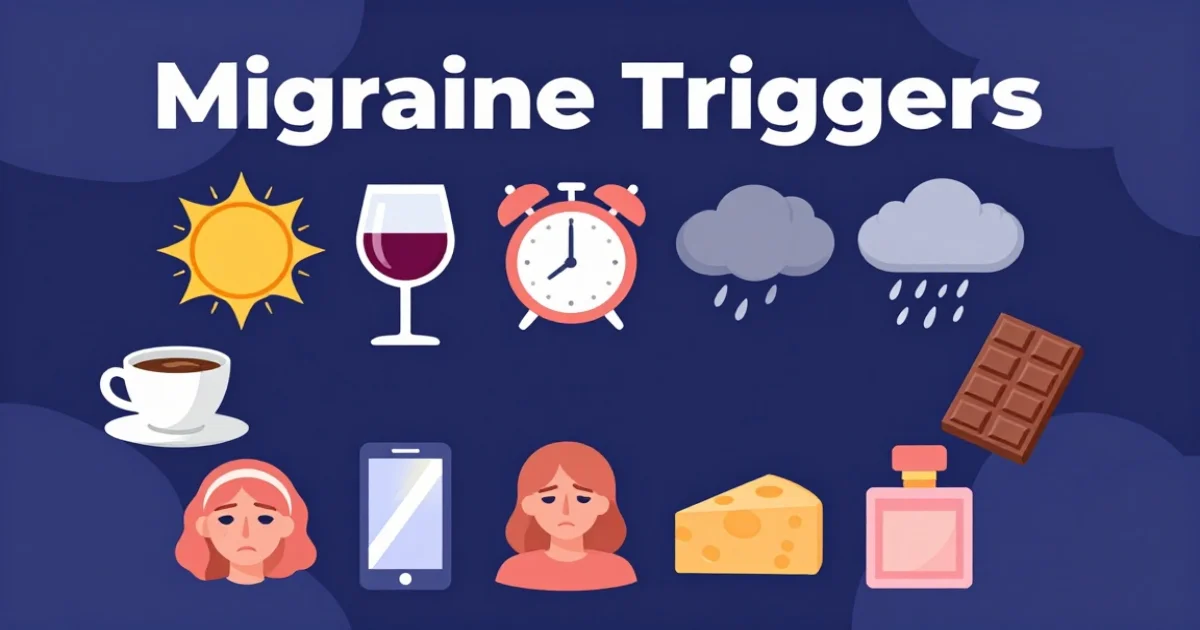
10 Most Common Migraine Triggers and How to Track Them
Stress, hormones, and weather are top migraine triggers. Learn to identify your personal triggers and reduce attack frequency by 30–50% with a tracking diary.

Migraine Food Triggers: What the Evidence Actually Says
62.5% of migraineurs avoid at least one food as a trigger. Learn which foods cause migraines, how they work, and how to find your real dietary triggers.

How to Get Rid of a Headache: Natural Methods That Work
40% of adults experience headaches. Most respond to natural treatment. Learn proven methods to relieve headache pain fast without medication.