How to Stop a Migraine: Step-by-Step Natural Relief
Migraine ranks third among global disability causes. Learn proven strategies to stop attacks — dark room rest, cold therapy, and breathing techniques for fast relief.
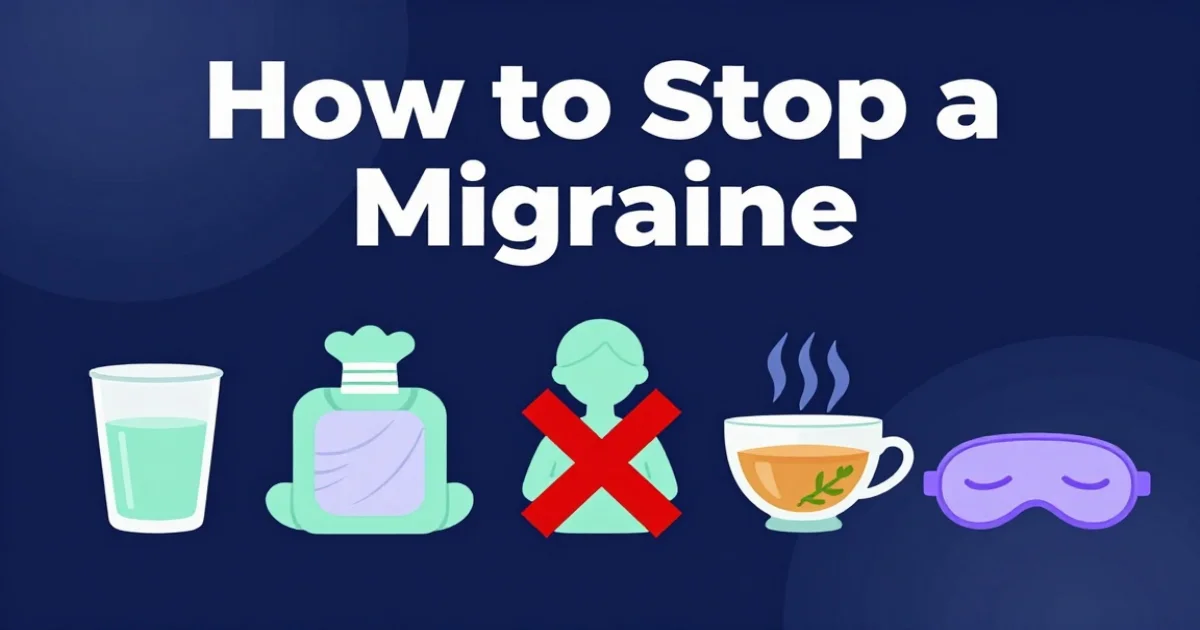
Migraine is one of the most disabling neurological conditions in the world. According to the World Health Organization, it ranks as the third leading cause of disability globally. When an attack strikes, the question on every sufferer's mind is the same: how do I make this stop?
This guide walks you through evidence-informed, natural strategies you can use right now to reduce migraine pain and shorten an attack. We cover everything from the moment you feel the first warning sign through the recovery phase. None of these approaches require a prescription, and all are compatible with whatever treatment plan your doctor has outlined.
Understanding your own migraine patterns is equally important. If you are not already tracking your attacks, learning about the benefits of keeping a migraine diary is a powerful next step. For general relief strategies that work across all headache types, how to get rid of a headache covers the foundational approaches. Data you collect between attacks can make each individual attack easier to manage. In tracking data from Calma users, people who log early warning signs within the first 10 minutes of noticing symptoms report shorter attack durations on average.
What Happens in Your Brain During a Migraine Attack?
A migraine is not simply a bad headache. It is a neurological event involving waves of electrical and chemical changes that spread across the cortex, triggering inflammation around the trigeminal nerve and causing the blood vessels surrounding the brain to dilate and throb. This process, known as cortical spreading depression, is what produces the full symptom constellation: throbbing pain, nausea, extreme sensitivity to light and sound, and in some people, visual or sensory aura.
Because migraine is driven by the nervous system, many natural interventions work by calming the nervous system response, reducing sensory overload, or interrupting the chemical cascade early in the attack. The goal is not to eliminate the migraine entirely through self-care, but to reduce its intensity and duration while supporting your body's natural recovery systems.
How Do You Catch a Migraine Before It Peaks?
The most effective window for stopping a migraine is before the headache itself begins. Many people experience a prodrome phase, subtle warning signs that appear 2 to 48 hours before head pain arrives. Common prodrome signals include yawning, neck stiffness, mood changes, food cravings, and fatigue.
If you learn to recognize your personal prodrome, you can start every intervention listed below while your nervous system is still in an earlier, more responsive state. Calma users who log early signs consistently report that their self-care interventions work better when started during prodrome rather than after the headache phase has fully developed.
This is one of the core reasons tracking your migraine patterns over time is so valuable. It teaches you your own early-warning system. You begin to notice the signals that used to seem random are actually predictable. Over time, this knowledge becomes one of your most powerful tools.
Step 1: Why Should You Retreat to a Dark, Quiet Environment?
When a migraine is building, your brain is hypersensitive to every incoming signal. Noise, light, and movement all amplify pain through a process called central sensitization. An ordinary fluorescent light can feel unbearable during an attack.
Find the darkest, quietest space available as quickly as possible. Close blinds. Turn off screens and overhead lights. Reduce all sources of sound. If you cannot get complete darkness, a sleep mask makes a meaningful difference.
This single step removes sensory input, which directly reduces the neural burden on an already overwhelmed brain. Neurologists consistently recommend this as a first-line self-management strategy. It requires no equipment and no training. Just darkness and quiet.
Step 2: Does Cold or Heat Therapy Help Stop a Migraine?
Cold and heat therapy are among the most widely used non-pharmacological migraine interventions. Research reviewed by the National Institutes of Health has demonstrated clinical benefit in reducing pain intensity during attacks.
Cold therapy is generally preferred during the headache phase. Apply a cold pack or a bag of frozen vegetables wrapped in a cloth to your forehead, temples, or the back of your neck for 15 to 20 minutes. This constricts dilated blood vessels and provides a numbing effect that blunts pain signals.
Heat therapy is sometimes more effective for neck and shoulder muscle tension that accompanies or precedes a migraine. A warm compress or heating pad on the neck and upper shoulders relaxes the tight muscles that are often both a trigger and a symptom.
Experiment with both. Your pattern may vary depending on the attack type.
Step 3: How Does Hydration Help During a Migraine?
Dehydration is both a common migraine trigger and a consequence of an attack in progress. According to the American Migraine Foundation, even mild dehydration can activate a migraine in susceptible individuals. Nausea or vomiting during an attack can worsen fluid loss rapidly.
At the first sign of an attack, drink a full glass of water slowly. If you are nauseous, small frequent sips are easier to tolerate than large amounts at once. Electrolyte drinks or oral rehydration solutions can help if vomiting has occurred, as they replace sodium and potassium lost through fluid loss.
Avoid iced drinks if cold sensitivity is present. Avoid alcohol entirely during an attack. Alcohol is a vasodilator that will worsen throbbing head pain.
Step 4: Can Breathing and Relaxation Techniques Stop a Migraine?
Stress and anxiety activate the sympathetic nervous system, the fight-or-flight response. This amplifies pain perception and can extend the duration of an attack. Controlled breathing shifts your body toward parasympathetic activation, reducing physiological stress markers and potentially shortening the attack.
Diaphragmatic breathing: Inhale slowly through the nose for a count of four, allowing your abdomen to expand. Hold for four counts. Exhale slowly through the mouth for a count of six to eight. Repeat for five to ten minutes. Short sessions add up.
Progressive muscle relaxation: Starting at your feet, deliberately tense each muscle group for five seconds and then release completely. Work upward toward your face. This technique reduces total-body muscle tension and lowers the pain amplifying effect of stress hormones.
Biofeedback: Though typically used as a preventive strategy, biofeedback training has been recognized by the Mayo Clinic as an effective non-drug migraine treatment. Benefits carry over into acute attacks for people who practice regularly.
Step 5: Does Acupressure Help With Migraine Pain?
Acupressure, applying firm pressure to specific points on the body, is a non-invasive technique that some migraine sufferers find effective for reducing pain intensity. The most studied point for headache and migraine relief is LI-4, located in the webbing between the thumb and index finger on either hand.
Apply firm circular pressure to this point for one to two minutes while taking slow breaths. A second commonly used point is PC-6, located on the inner wrist about three finger-widths above the wrist crease. This point may help with accompanying nausea.
The NIH's National Center for Complementary and Integrative Health notes that acupressure carries no risk and is appropriate to try alongside other strategies. The evidence for acupressure as a standalone migraine treatment is still developing, but many people find it a helpful complement to other approaches.
Step 6: Can Ginger Relieve Migraine Nausea and Pain?
Ginger has been studied as a natural option for both migraine pain and the nausea that so often accompanies attacks. A study referenced by the American Migraine Foundation found that ginger powder was comparable to a common migraine medication in reducing pain severity, with fewer side effects.
You can use ginger as a tea. Steep a teaspoon of freshly grated ginger in hot water for ten minutes. Ginger chews or capsules are also options. Ginger is generally well tolerated and safe for most people.
Consult your doctor if you take blood thinners, as ginger has mild anticoagulant properties.
Step 7: Why Does Sleep Help Stop a Migraine?
Sleep is one of the most powerful natural migraine-terminating mechanisms available. Many people wake from sleep with their migraine significantly reduced or completely resolved. Why? Sleep allows the nervous system to reset. It reduces circulating stress hormones. It removes you from the sensory environment driving pain amplification.
If sleep is not possible during an attack, even lying still in a dark room with eyes closed, a state of quiet rest, can reduce pain intensity. Avoid screens. Blue light stimulates cortical excitability precisely when you need the opposite.
Disrupted or insufficient sleep is also one of the most reliable migraine triggers. Prioritizing consistent sleep hygiene serves both as an acute relief strategy and a long-term preventive one.
Step 8: How Do You Manage the Migraine Postdrome (Hangover)?
When the headache phase finally lifts, many people feel drained, foggy, or emotionally flat for 24 to 48 hours. This "migraine hangover," known as the postdrome, is part of the migraine cycle and deserves as much attention as the attack itself.
During the postdrome, continue to rest as much as possible. Eat gentle, low-glycemic foods to stabilize blood sugar. Avoid the temptation to immediately catch up on everything you missed. Overexertion in the postdrome can trigger a rebound attack.
Gentle hydration, light movement such as slow walking, and avoiding caffeine surges or alcohol will help your nervous system recover fully. Your brain has just been through a significant neurological event. Treat it accordingly.
How Do You Use Trigger Knowledge to Stop Future Attacks Sooner?
Stopping an attack in progress is important. But preventing the next one, or catching it earlier, is even more powerful. Migraine triggers vary significantly between individuals. Common categories include dietary factors, hormonal fluctuations, sleep disruption, environmental stimuli, and emotional stress.
Understanding the difference between a true migraine and other headache types also matters. Not every severe headache is a migraine. Misidentifying the type can delay effective management. Our guide on migraine vs. headache explains the key differences in detail.
You can also explore the most common migraine triggers to build a more complete picture of what may be driving your attacks.
Tracking your attacks consistently, including what you ate, how you slept, your stress level, and environmental conditions, builds the evidence base that lets you and your neurologist make targeted decisions. Calma's iOS app was built specifically for this: logging attacks, identifying trigger patterns, and generating reports you can share with your care team.
When Should You Consult a Doctor About Your Migraines?
Natural strategies are effective for many people, but they are not a substitute for medical care in all cases. Consult a neurologist or your primary care physician if your migraines occur more than four days per month, if your attacks last longer than 72 hours, if your headaches are not responding to any self-care strategies, or if you are missing work, school, or social obligations regularly due to migraines.
Seek emergency care immediately if you experience the worst headache of your life, especially if sudden in onset. Also seek emergency care for headache with fever and stiff neck, headache with vision loss, weakness, confusion, or speech difficulty, or headache following a head injury. These symptoms can indicate a serious medical emergency unrelated to migraine.
Download on the App Store
Frequently Asked Questions
What stops a migraine fast naturally?
The fastest natural approaches are retreating to a dark, quiet room; applying a cold compress to your forehead or neck; drinking water if you may be dehydrated; and practicing slow, diaphragmatic breathing to calm the nervous system. Starting these at the first sign of an attack gives you the best chance of reducing severity before the pain peaks.
How long does a migraine typically last?
According to the WHO, a migraine attack can last anywhere from 4 to 72 hours if untreated. Duration varies by individual and attack type. Acting quickly at the prodrome or aura phase, before the headache peaks, is so important.
Can caffeine help stop a migraine?
In small amounts, caffeine can enhance pain relief and constrict dilated blood vessels, which is why it appears in some over-the-counter pain formulas. However, regular or excessive caffeine use can itself trigger migraines and lead to rebound headaches. If you use caffeine strategically during an attack, limit it to occasional use and discuss it with your doctor.
When should I see a doctor for a migraine?
You should seek medical advice if your migraines occur more than four days per month, if they are not responding to any self-care strategies, or if the character of your headaches changes suddenly. Go to an emergency room immediately if you experience the worst headache of your life, a headache with fever and stiff neck, sudden-onset headache, or headache with neurological symptoms such as vision loss, weakness, or confusion.
Related Articles
Migraine and Nausea: Why It Happens and How to Cope
Nausea affects many migraine sufferers. Learn why it happens, evidence-based coping strategies, and how tracking your symptoms leads to better relief.
What Is Migraine Aura? Symptoms, Types, and What to Do
Migraine aura affects 25-30% of people with migraine. Learn what aura symptoms feel like, the types, why they happen, and when to seek medical advice.
How to Get Rid of a Headache: Natural Methods That Work
40% of adults experience headaches. Most respond to natural treatment. Learn proven methods to relieve headache pain fast without medication.